

Quantum Secure Direct Communication (QSDC) Simulation System
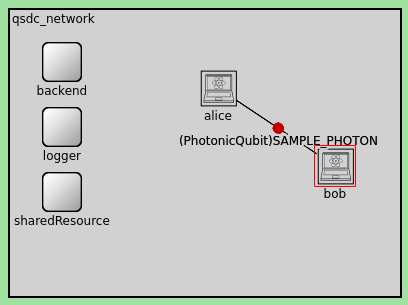
Quantum Secure Direct Communication (QSDC) is one of the earliest quantum communication algorithms capable of transmitting information through quantum packets, relying on classical communication only for coordination and support. Although its theoretical foundations are well established, practical implementations that address pragmatic issues remain limited. This report presents the design and implementation of a modified QSDC protocol within a network simulation environment, the Quantum Internet Simulation Package (QuISP), based on the original protocol by Long, Deng, Wang, Li, Wen, and Wan [1]. The system introduces key modifications to accommodate practical constraints of the environment, resulting in a three-phase structure consisting of entanglement verification, quantum channel verification, and message transmission using superdense coding. Experimental results demonstrate that the modified system can reliably detect an eavesdropper through elevated error rates. If the adversary manages to evade detection, eavesdropping on the transmitted message introduces noticeable errors while still preventing the extraction of meaningful information about the original message. These results highlight the feasibility of implementing QSDC in a networked environment. [1] G.-L. Long, F.-G. Deng, C. Wang, X.-H. Li, K. Wen, and W.-Y. Wang, “Quantum secure direct communication and deterministic secure quantum communication,” Frontiers of Physics, vol. 2, no. 3, pp. 251–272, 2007.