

Medical Image Classifier with Uncertainty-Aware Triage and Robustness Testing
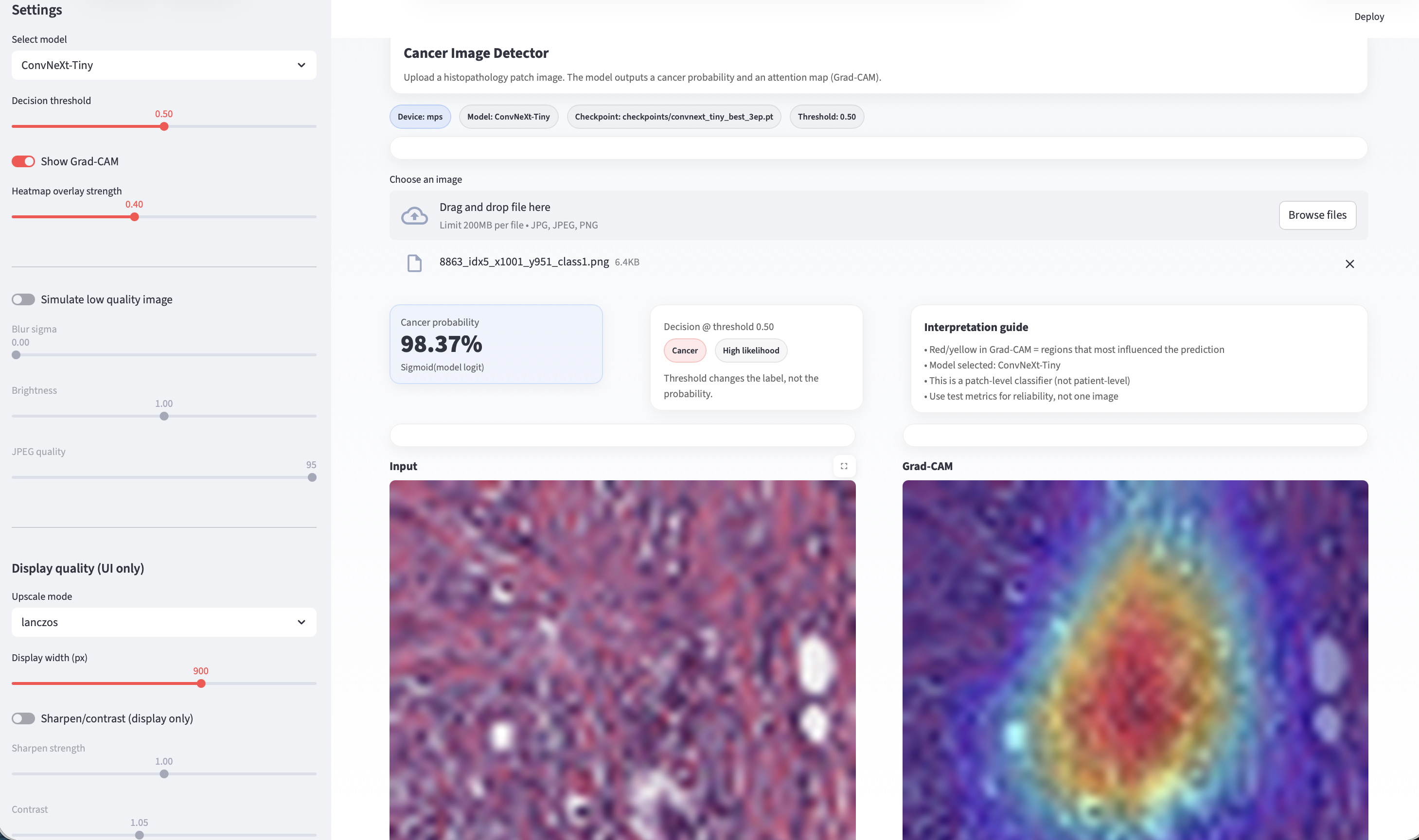
To date, histopathological examination has been the gold standard for cancer diagnosis. However, this approach is subject to several challenges. For example, manual review of histopathology image patches is time-consuming, subjective, and dependent on the pathologist's interpretation of the tissue. Advances in deep learning have underscored the potential support that such systems can provide for pathologists in the detection of malignancies at the tissue level. This project aims to implement a research-grade binary cancer detection system based on convolutional neural network (CNN) models applied to histopathology image patches from the Kaggle IDC Histopathologic Cancer Detection dataset. The model classifies image patches into either cancerous (1) or non-cancerous (0). The emphasis is on the comparison and reproducibility of the CNN architecture, explainability, and realistic deployment, rather than on accuracy. Five convolutional neural network models, EfficientNet-B0, DenseNet-121, EfficientNetV2-S, ConvNeXt-Tiny and ResNet-18, are trained and evaluated on the same data splits (training, validation and test) to ensure comparable results. Model performance is assessed using clinically relevant metrics, including sensitivity, the area under the receiver operating characteristic (AUROC) curve, and the F1-score, the harmonic mean of precision and recall. The EfficientNet-B0 model achieves an ROC-AUC of 0.966, outperforming the ResNet-18 baseline and generalising well. To enhance explainability, Gradient-weighted Class Activation Mapping (Grad-CAM) is utilised to visualise the spatial features that contribute to the model's predictions. The trained models are then deployed in an interactive web application built with Streamlit, which includes a threshold-based decision-making process and explainability functions. The project is positioned as a decision-support research system rather than a diagnostic tool, and the limitations are acknowledged.