

Developing an Eye-Tracking Analysis Tool for Evaluating Head-Up Displays (HUDs) in Driving
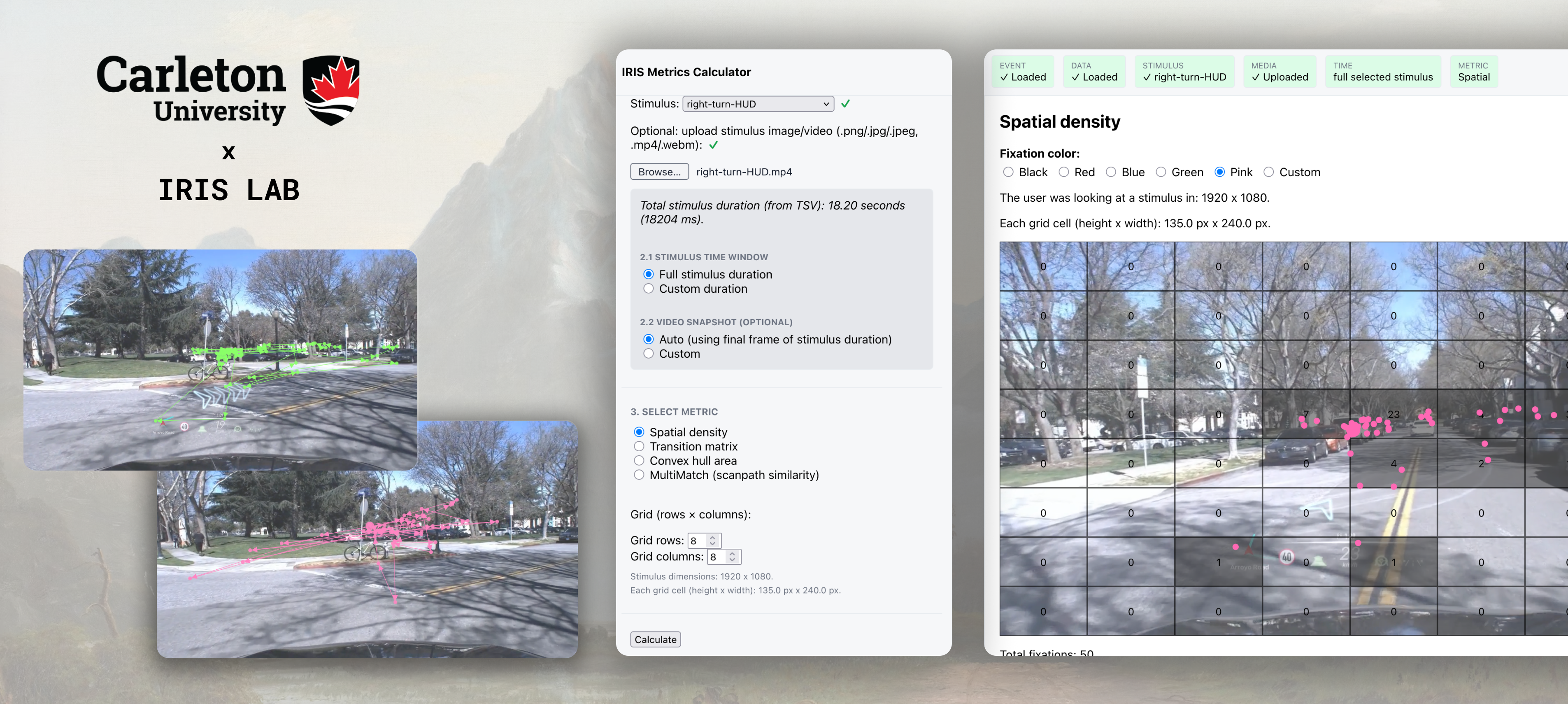
Eye-tracking is an important method in Human-Computer Interaction (HCI) because it gives researchers an objective way to study how visual attention is allocated over time. This is especially relevant in driving-related contexts, where attention is closely tied to safety, awareness, and decision-making. However, although software such as Tobii Pro Lab makes eye-tracking data relatively easy to collect and export, calculating more advanced eye-tracking metrics from that data is still often fragmented, manual, and inconvenient in practice. This creates a gap between collecting eye-tracking data and being able to analyze it through more complex and richer metrics in a way that is consistent, usable, and reusable. This honours project addresses that gap through the development of the Iris Metrics Calculator, an eye-tracking calculator tool built for the Carleton University IRIS lab. The tool was designed to work alongside the lab’s existing Tobii Pro Lab eye-tracking workflow and support the calculation of four advanced metrics that are relevant to interface and driving-related analysis: spatial density, transition matrix, convex hull area, and MultiMatch scanpath similarity. Overall, the goal of the project was to implement these metrics and allow visualizations for them in a way that makes them more accessible through a simpler and more unified workflow. The effectiveness and functions of the tool was evaluated through two forms of practical testing. First, informal functional testing was used to confirm that the implemented metrics and visual outputs worked as intended on simple stimuli. And then second, a small driving-related pilot application using HUD and non-HUD clips was conducted to test the tool’s functionality on real eye-tracking recordings in a context relevant to the lab’s wider research focus. This pilot was mainly used to demonstrate feasibility, practical use, and workflow fit rather than to support strong generalizable claims about HUD effects themselves. Overall, the project allows for advanced eye-tracking metrics to be integrated into a more structured workflow that better supports practical lab use. This Iris Metrics Calculator acts as a practical bridge between raw Tobii export data and higher-order eye-tracking analysis, helping make advanced metric calculation more consistent, usable, and accessible within the IRIS lab context.