

Belief-Aware Stackelberg Control for Adaptive Cancer Therapy: The Cost of Partial Observability
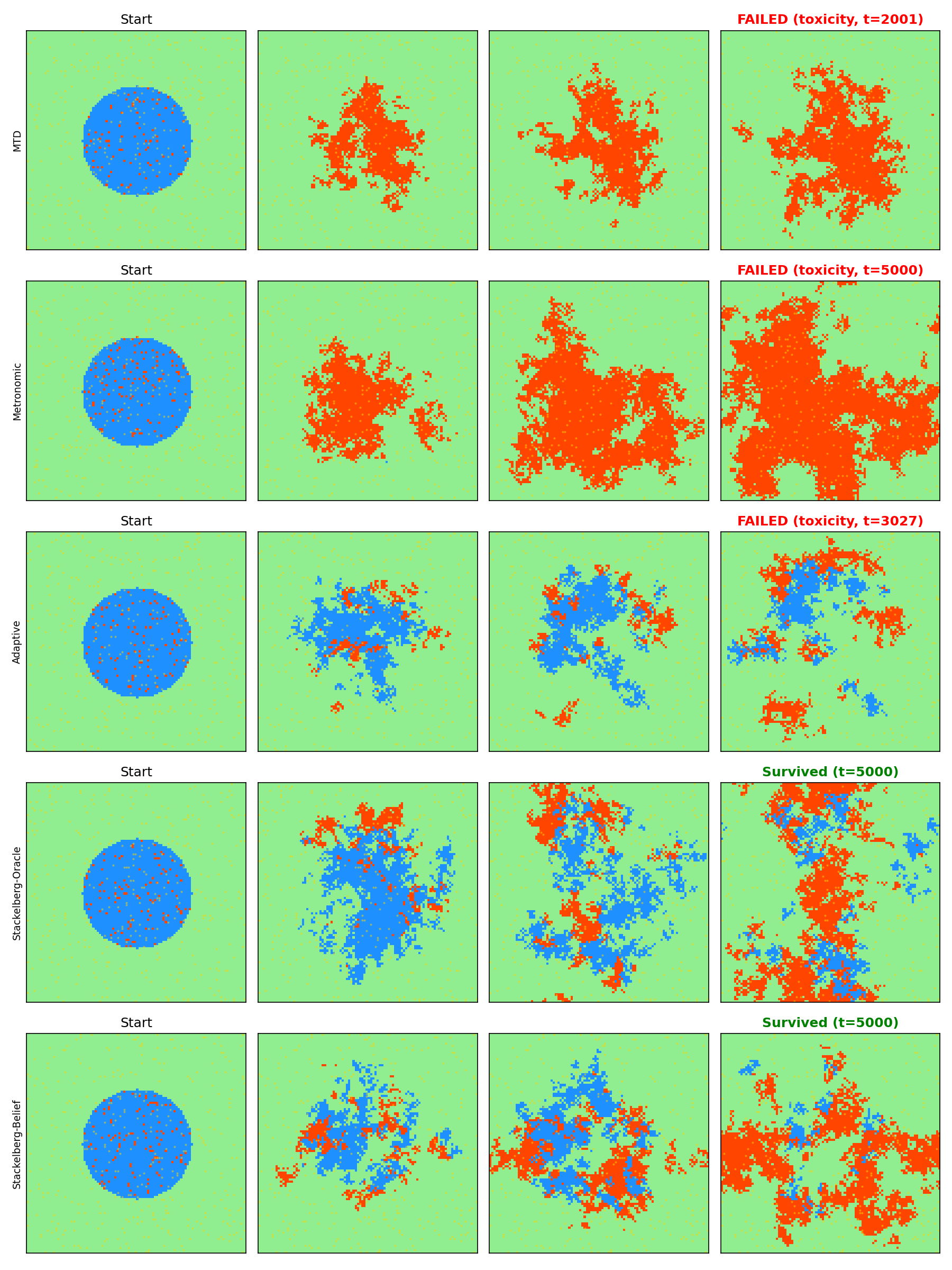
Stackelberg adaptive-therapy policies can outperform standard baselines in spatial cancer simulators, but typical formulations assume the controller has direct access to the underlying sensitive and resistant cell counts, an idealisation that real clinical imaging cannot provide. This work removes that idealisation by introducing a Bayesian particle filter over the hidden resistance fraction, updated only from tumour burden observations, and rewrites the Stackelberg controller’s decision rules in terms of the resulting belief. Across 300 Monte Carlo runs the belief-aware variant (Stackelberg-Belief) survives every run, matching the perfect-information Oracle, while MTD, metronomic, and Gatenby adaptive baselines each survive 0/300. The cost of partial observability is a 25% premium in cumulative budget (514 vs 411 units) and reduced sensitive-cell preservation. The filter tracks the true resistance fraction with a mean absolute error of about 0.12, consistent with the observation channel’s signal-to-noise ratio. Per-patient variance is driven by the channel’s information limit and unmodelled inter-patient drift heterogeneity. All results are in-distribution and should not be read as evidence of outof-distribution generalisation.