

Neural Network-Based Cheating Detection for CoMas
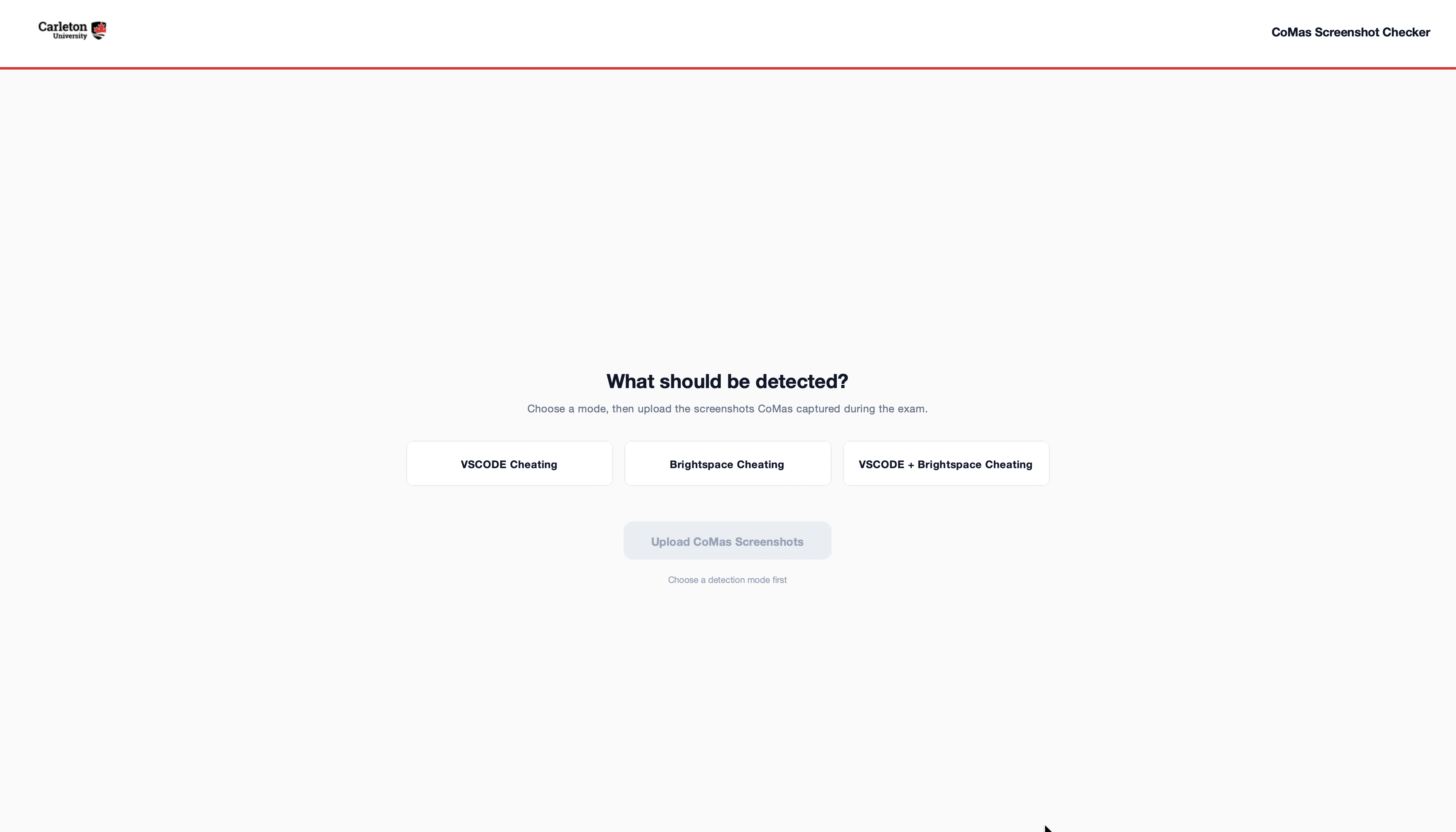
CoMas is the proctoring tool Carleton University uses for online exams. It takes screenshots of each student's desktop throughout an exam, and someone has to look at every one of them. A single assessment can produce thousands of images. Nobody can review that many carefully, so review ends up rushed and inconsistent from one marker to the next. This project builds a screening layer that sorts the screenshots by how suspicious they look, so a proctor starts with the ones most worth their time instead of clicking through everything. It looks for two things: an AI coding assistant in Visual Studio Code, and a student who has navigated away from their Brightspace quiz. The main finding is that those two problems need completely different tools. A chat panel and a quiz page both have telltale words on screen, so reading the text and matching keywords catches them reliably. Inline ghost text is different. It is the dimmed code an assistant suggests at your cursor, and it contains no giveaway words at all, so it just looks like ordinary code in a lighter shade. Text extraction wouldn’t know it’s an AI tool. Finding ghost text needs a model that looks at the picture rather than the words, so a ResNet50 was fine-tuned for the job. Real CoMas screenshots were not available, so the training images were generated instead. 300 positives and 300 negatives images with ghost text were generated and trained on the shipped model. Seven trained models were tested on generated images and on 27 real ones, and the two sets of results pointed in opposite directions. The model that looked best on generated data, at 0.999, was among the worst on real screenshots at 0.786. A model near the bottom on generated data came out near the top on real ones at 0.901. The version that shipped scores small tiles of the screenshot at full resolution. It finds 11 of 14 real ghost-text screenshots with 1 false alarm out of 13. The final submission is a desktop application that scores a folder of screenshots, presents them in a ranked queue, and exports the evidence in a form suitable for an academic integrity case.